

Access to reliable health information does not begin and end in a hospital. Sometimes, it begins with simply knowing where a health facility is, what it looks like, and that it exists. In Ikwerre Local Government Area (LGA) of Rivers State, Nigeria, many maternal and child health facilities remain poorly documented and difficult to find online. Addressing this gap also requires communities to have the digital literacy skills and opportunities to create and share knowledge online. For women who are caregivers and nursing mothers, participating in Wikimedia activities can be challenging when time, caregiving responsibilities, and the pace of conventional events become barriers. Creating flexible and supportive spaces allows these women to learn and contribute at their own pace, without feeling pressured to keep up with younger or more experienced contributors.
These needs inspired “Bridging Access: Mapping Maternal and Child Health Facilities in Ikwerre LGA, Rivers State,” a Wikimedia project that combined digital literacy, community participation, and local documentation and was funded by the Nigerian National Funding Program. Participants documented maternal and child health facilities across Ikwerre LGA through photography and structured data, contributing information to Wikimedia Commons and Wikidata and making locally relevant health infrastructure more visible online.
Project implementation
Onsite Launch
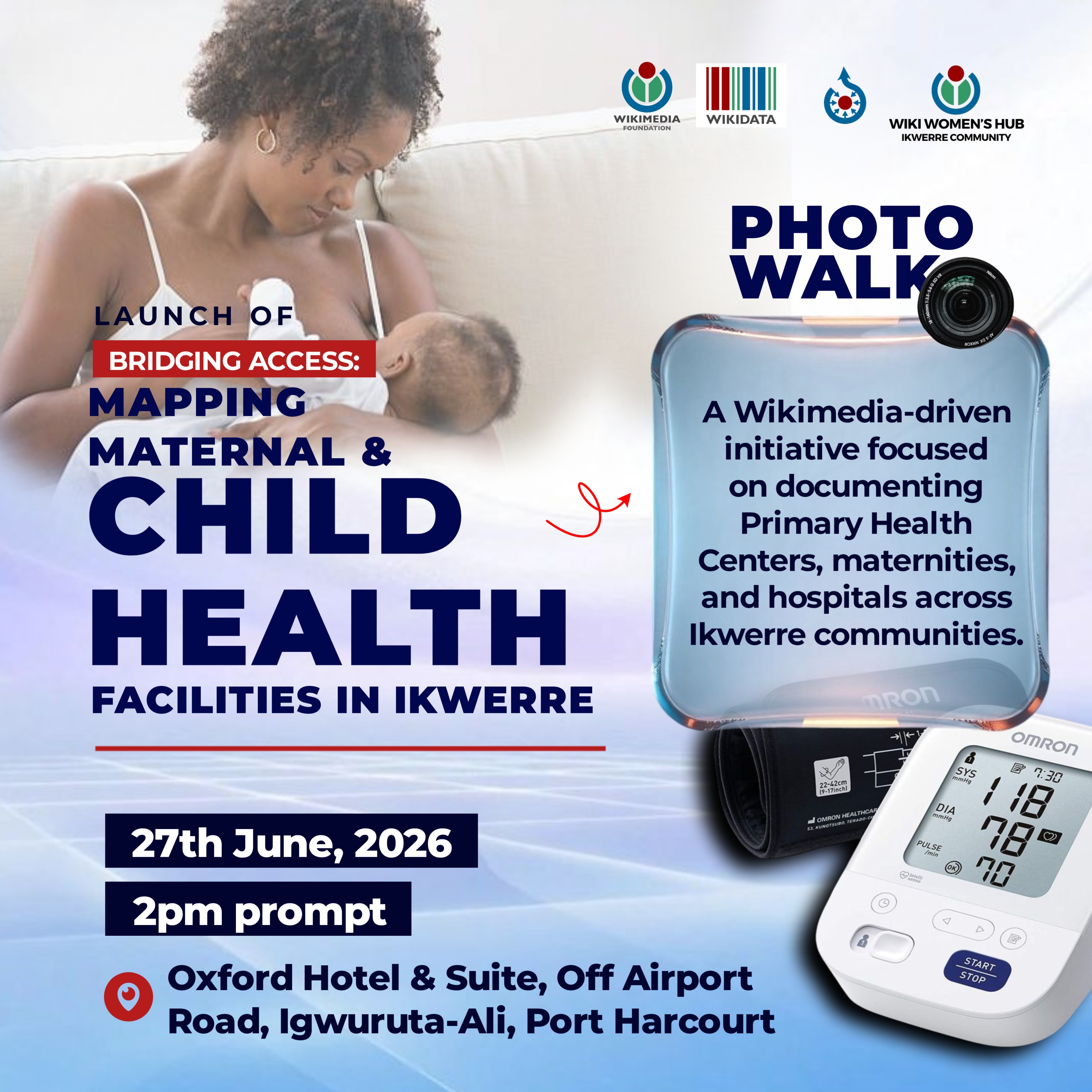

The project began with an onsite launch and practical training session attended by 45 mothers, primarily nursing mothers and women with young children from the Ikwerre community. Using health facilities they already visit for antenatal care, child healthcare, and other routine needs as an entry point, participants were introduced to Wikimedia and taught practical digital literacy skills, including creating Wikimedia accounts, joining online meetings, setting up their phones for effective photography, documenting health facilities, and collecting basic information such as names, locations, and facility details. They also learned how to upload photographs to Wikimedia Commons. The session was designed to make participation accessible and manageable alongside caregiving responsibilities, giving women the opportunity to learn, practise, and contribute at their own pace. Following the training, participants began visiting health facilities across Ikwerre LGA to photograph and document them, transforming familiar places in their communities into openly accessible knowledge while building their confidence and capacity to participate in the Wikimedia movement.
Photowalks: Learning by Doing


The photowalks took place in three ways, giving participants different levels of support and flexibility. First, three general photowalks brought the women together to travel by hired bus to about eight (8) health facilities per outing. Along the way, they revisited what they had learned during the launch and practised documenting each facility by recording its name and location and capturing photographs from different angles. Second, in-group photowalks allowed participants to organise themselves into smaller groups based on where they are located, making it easier to visit facilities within their respective areas. Finally, solo photowalks gave each woman the flexibility to visit and document health facilities independently, allowing her to contribute around her caregiving responsibilities and at her own pace. Together, these three approaches created a gradual pathway from shared learning to independent participation while ensuring that women could remain active contributors regardless of their schedules or circumstances.
Online Session: Turning Fieldwork into Structured Knowledge


The online session was supported by User ChristLike and moderated by User Iwuala, while the project lead – User:Sylvaline39 and co-lead –User:Juliegwen provided behind-the-scenes support, helping participants log in and set up their devices. The session focused on turning participants’ field documentation into structured knowledge. They learned how to create Wikidata items for the health facilities they had documented, add relevant information, and identify reliable sources to support their contributions. It also provided an opportunity to review their work, answer questions, troubleshoot challenges, and reflect on the contributions made throughout the project.
Metrics


The project reached 13 wards and 40 communities/areas across Ikwerre LGA and documented approximately 67 maternal and child health facilities. By the end of the project:
- 45 participants attended the launch, exceeding the target of 40, while 37 participants successfully registered on the event page.
- 67 health facilities were photographed and mapped.
- 104 photographs were uploaded to Wikimedia Commons.
- 30 Wikidata items were created.
- 13 wards and 40 communities/areas were covered.
Beyond these outputs, 20 participants completed the survey and reported gaining practical digital and Wikimedia-related skills, demonstrating that the project strengthened participants’ capacity to document, contribute, and engage with Wikimedia projects. These outcomes demonstrate that the project created both tangible open-knowledge resources and valuable digital skills that participants can continue to apply beyond the project.
Project coordination
The project was coordinated by User:Sylvaline39, who served as the Project Lead, with support from the other facilitators. User:Juliegwen led communication, publicity, and facilitation during the onsite activities, helping participants stay informed and supporting the practical aspects of the training and fieldwork. User:Lucy Iwuala served as the online support and was responsible for monitoring the project. Her role helped ensure that the online component of the project remained connected to the field activities. User:King ChristLike served as the online trainer and documentation of project outcomes, helping to capture the contributions made. The collaboration among the facilitators was essential to keeping the project moving from planning and training to field documentation and online contributions.
Challenges
Like many community-led projects, the implementation faced several challenges. Some participants had limited technical knowledge and required repeated, hands-on guidance to complete tasks such as creating accounts, uploading images, and contributing to Wikidata. A number of participants also had older or poorly functioning mobile phones, while financial constraints limited their ability to replace or upgrade their devices. Network connectivity was another challenge, particularly for online activities and uploads. In addition, reliable sources for verifying and supporting information about some of the health facilities captured were not readily available, which limited our ability to create Wikidata items for those facilities; despite documenting approximately 100 facilities, 30 Wikidata items were successfully created. The rainy season and poor road conditions also affected field documentation, making it difficult for some participants to travel to health facilities for photowalks, while the higher-than-expected turnout at the launch created additional logistical demands. Despite these challenges, the team adapted through personalized support, follow-up, and flexible field activities, enabling participants to continue contributing and document health facilities across Ikwerre LGA.
Looking forward
“Bridging Access” is only a beginning. Beyond continuing to document health facilities and improve Wikidata records, the project has shown the importance of creating sustained spaces where women – particularly nursing mothers and caregivers – can participate in the Wikimedia movement without having to fit into rigid schedules or the pace of conventional programmes. These spaces should not be one-off opportunities; they should provide ongoing mentorship, connection, and opportunities for women to learn and contribute at their own pace, whenever their time and responsibilities allow and to topic that resonates with them. By intentionally making room for women’s participation, we can strengthen the diversity of Wikimedia communities while ensuring that the knowledge and places that matter to them are represented in the open knowledge ecosystem..
Project in Pictures: Activities and Photowalks

Participants of Bridging Access:Mapping Maternal & Child Health Facilities in Ikwerre LGA Rivers State 
Participants of Bridging Access:Mapping Maternal & Child Health Facilities in Ikwerre LGA Rivers State 
Participants of Bridging Access:Mapping Maternal & Child Health Facilities in Ikwerre LGA Rivers State 
Participants of Bridging Access:Mapping Maternal & Child Health Facilities in Ikwerre LGA Rivers State 
Participants of Bridging Access:Mapping Maternal & Child Health Facilities in Ikwerre LGA Rivers State 
Participants of Bridging Access:Mapping Maternal & Child Health Facilities in Ikwerre LGA Rivers State 
Participants of Bridging Access:Mapping Maternal & Child Health Facilities in Ikwerre LGA Rivers State 
Participants of Bridging Access:Mapping Maternal & Child Health Facilities in Ikwerre LGA Rivers State 
Participants of Bridging Access:Mapping Maternal & Child Health Facilities in Ikwerre LGA Rivers State 
Participants of Bridging Access:Mapping Maternal & Child Health Facilities in Ikwerre LGA Rivers State 
Participants of Bridging Access:Mapping Maternal & Child Health Facilities in Ikwerre LGA Rivers State 
Participants of Bridging Access:Mapping Maternal & Child Health Facilities in Ikwerre LGA Rivers State 
Participants of Bridging Access:Mapping Maternal & Child Health Facilities in Ikwerre LGA Rivers State 
Participants of Bridging Access:Mapping Maternal & Child Health Facilities in Ikwerre LGA Rivers State 
Participants of Bridging Access:Mapping Maternal & Child Health Facilities in Ikwerre LGA Rivers State
Can you help us translate this article?
In order for this article to reach as many people as possible we would like your help. Can you translate this article to get the message out?
Start translation