I began the African Wikipedian Alliance European Partnership for Democracy Digital Democracy Initiative (EPD-DDI) Enhancing Youth Voices and Youth Civic Engagement in a Secured Digital Space through it Digitise Youth fellowship thinking I already understood the terrain. I had worked in Wikimedia spaces before, led communities, and supported projects that reached beyond Nigeria, so I assumed this experience would mainly extend across my technical process for finding topics, identifying red links, and guiding contributors toward strong articles. What I did not expect was that the deepest lesson of the fellowship would not be about editing tools at all. It would be about how knowledge moves across Africa, and how often that movement is interrupted by language, sourcing barriers, and the unequal conditions under which some references are required to be documented.

One of the biggest shifts for me came when I began working through topics connected to countries such as Cameroon, Ethiopia, and Sudan. The issue was not always that information did not exist. In many cases, there was meaningful, valuable content, but the references were difficult to access, difficult to verify across languages, or difficult to adapt to the standards expected on English Wikipedia. That challenged one of my earlier assumptions. I had often thought that content gaps were mostly about missing knowledge. During this fellowship, I saw more clearly that they are also about language barriers, discoverability, and the limits of the tools we rely on to make knowledge usable.
The Gap in the Gap
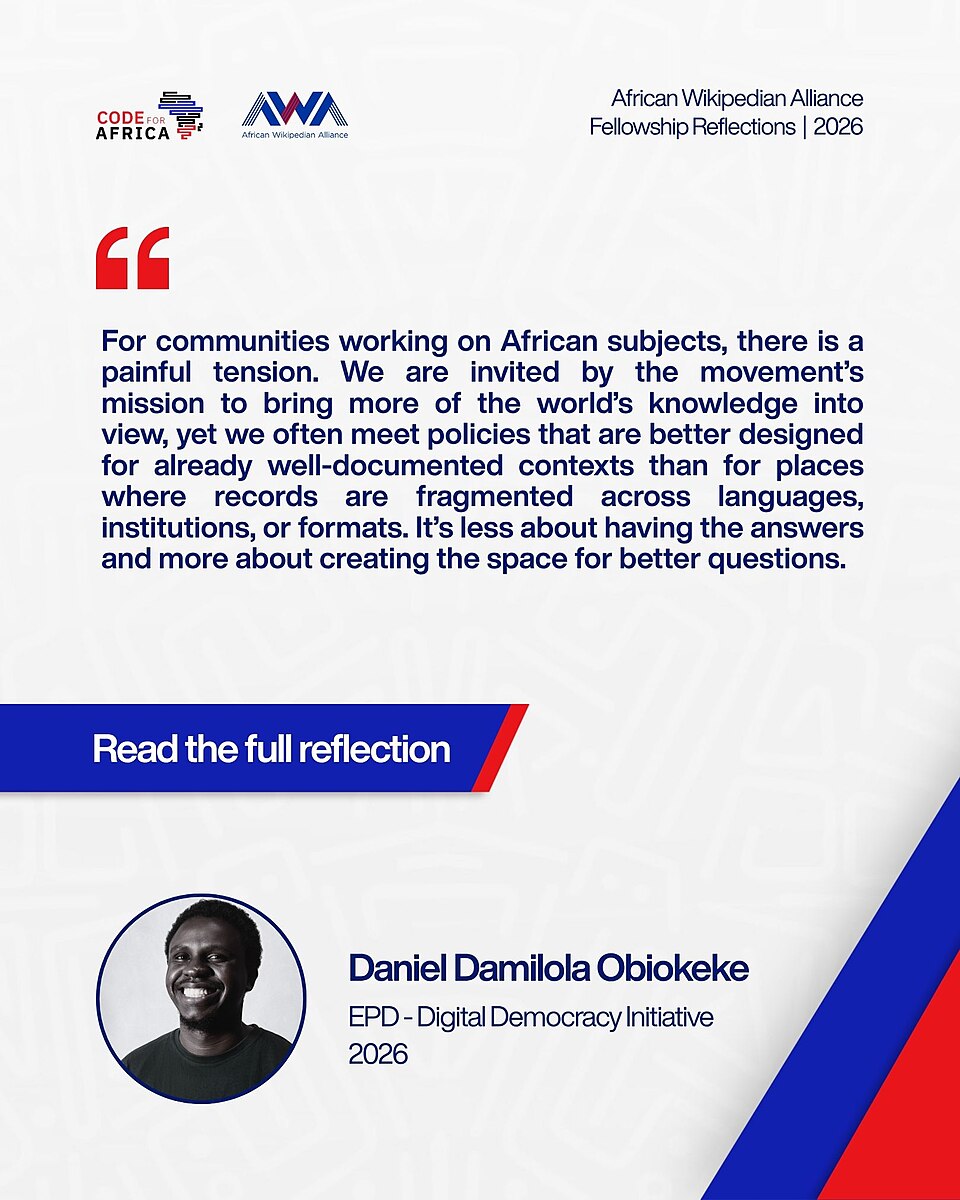
This realization matters to me because it changes how I understand Wikimedia itself. When a topic from an underrepresented context is missing, the problem is not always unwilling contributors or lack of interest. Sometimes the knowledge exists, but the path to verifying and presenting it is much harder. For communities working on African subjects, this creates a painful tension. We are invited by the movement’s mission to bring more of the world’s knowledge into view, yet we often meet policies that are better designed for already well-documented contexts than for places where records are fragmented across languages, institutions, or formats.
Remote Learning Has its Limits
Another lesson from this fellowship was more personal. I learned that teaching and mentoring new contributors online is much harder than I had admitted to myself. In physical community spaces, I have often been able to read confusion, hesitation, or excitement in real time and respond with patience. Online, much of that disappears. You cannot easily tell when someone is lost, distracted, or quietly discouraged. That forced me to rethink not only my patience, but also my teaching style. I now see that remote mentorship requires more intentional feedback, more spaced learning, and more supportive structures than I once assumed.
What stays with me, then, is not only a sharper understanding of Wikimedia’s knowledge gaps, but also a more grounded sense of what meaningful contribution requires. Pan-African work cannot be treated as if every context is equally searchable, equally documented, or equally legible to global systems of verification. If we truly care about knowledge equity, then we need better tools, more contextual flexibility, and communities that are supported not just to contribute, but to persist.
Conclusion
As I look ahead, I know I will approach multilingual projects and remote programs differently. What excites me most is the possibility of a future where Africans overcome unfavorable policies instead of avoiding them and, in the process, allowing content gaps to widen.
This Diff post is part of the African Wikipedian Alliance (AWA) Fellowship Programme 2026, an initiative supporting African Wikimedians to contribute to closing knowledge gaps across Wikimedia projects while strengthening their skills, experiences, and communities. Through the fellowship, fellows contribute to Wikimedia projects, engage with knowledge gaps across African contexts, and share reflections on their learning and experiences throughout the programme.
The AWA Fellowship Programme is coordinated by Code for Africa and delivered in collaboration with partners supporting the growth and development of African Wikimedia communities.
Can you help us translate this article?
In order for this article to reach as many people as possible we would like your help. Can you translate this article to get the message out?
Start translation